Where is the restaurant losing time or product?
Follow food and information through the entire operation to identify repeated work, unnecessary movement, waiting, inconsistent portions, and gaps between stations.
 ™AK ALPHA DATAKeep Life Moving in the Right Direction™
SERVICES / RESTAURANT & HOSPITALITY
Review the whole restaurant: its people, food flow, equipment, and computer systems. Find practical ways to reduce wasted effort, improve production and service, and make better use of the resources you already have.
THE BUSINESS VALUE
Follow food and information through the entire operation to identify repeated work, unnecessary movement, waiting, inconsistent portions, and gaps between stations.
Review how devices, software, and equipment support the work, where outages or service problems interrupt it, and whether targeted changes could improve reliability and capacity.
Evaluate how preparation, line replenishment, plating, and front-of-house handoffs affect productive time, remakes, service speed, and the capacity to serve guests.
Map receiving, storage, preparation, movement to the cook’s line, plating, and delivery to the guest. Review staging, replenishment, station layout, and handoffs for unnecessary movement or delays.
Review computers, networks, POS connections, kitchen displays, printers, handheld devices, and the software supporting daily work. Identify where configuration changes, better connections, or new technology could help.
Inventory kitchen and supporting equipment, its purpose, condition, service providers, maintenance needs, and existing service arrangements. Identify operational dependencies and priorities for repair, replacement, or further specialist assessment.
Examine how ingredients are portioned, prepared, labeled, stored, and brought to the line. Look for practical changes that support consistent portions, timely replenishment, and more organized production.
Clarify station responsibilities and the handoffs between prep cooks, line cooks, expo, servers, and support staff. Develop practical guidance so teams understand how their work affects the next person and the guest.
Connect purchasing, recipe costs, prep yields, inventory, and recorded waste with operating activity. Evaluate proposed changes against staff time, food costs, service performance, and the cost of implementation.
OUR APPROACH
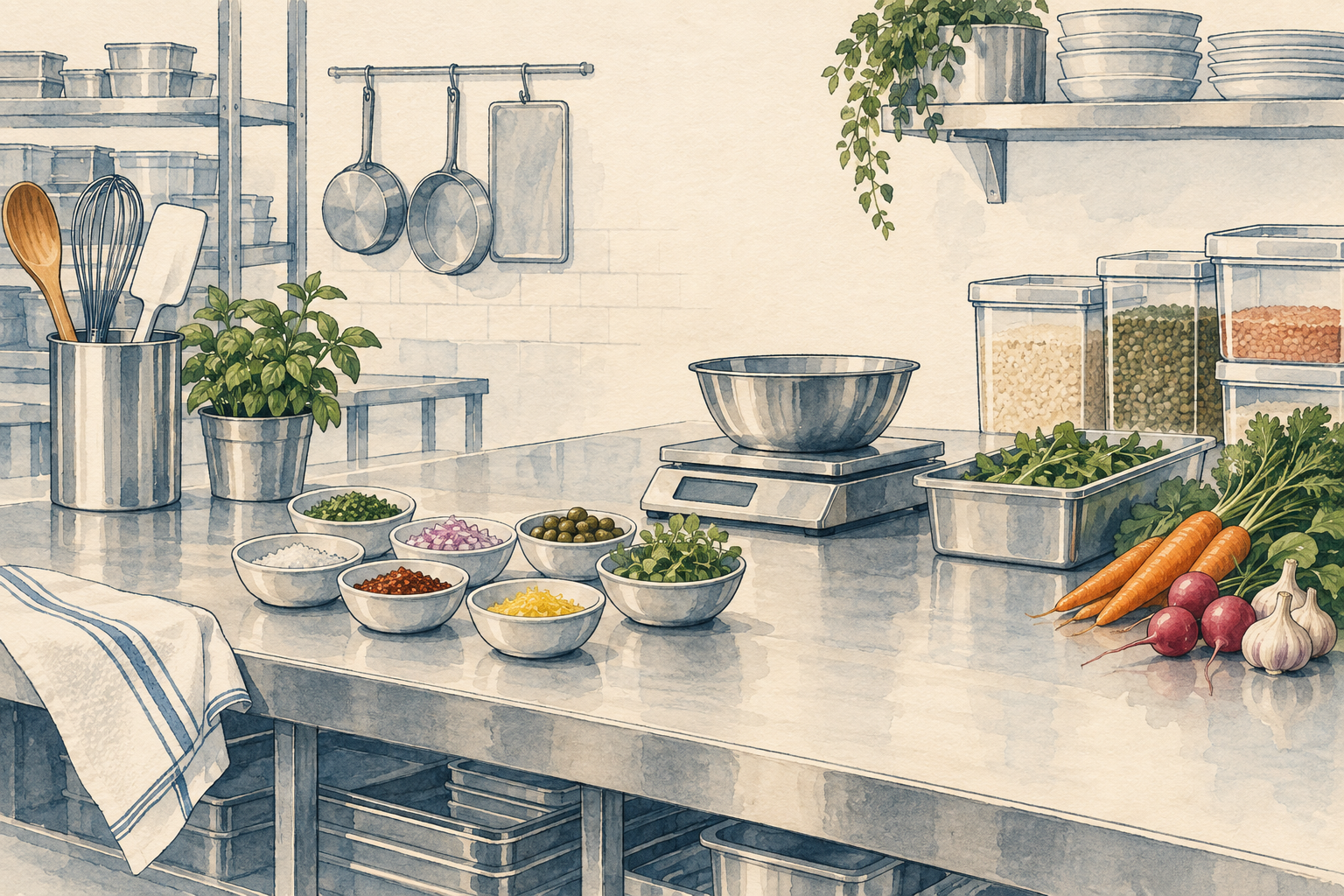
Practical knowledge of restaurant operations informs reviews of food production, station organization, equipment, technology, and team coordination. Collaborative assessment connects each part of the operation with the next.
Deliverables are selected and agreed for your project.
Recommendations are shaped around the restaurant’s menu, layout, staffing, budget, vendor schedules, and service model. The aim is a coordinated operation that the team can sustain, with training and clear ownership of the changes.
Possible measures, selected to fit your goals:
We establish a starting point, agree on targets, and review results alongside implementation and ongoing costs. Time released creates capacity; it is not automatically cash savings. Revenue opportunities are evaluated alongside the cost of delivering them.
Begin with a walkthrough of the operation and available records. Compare adjustments to existing processes with equipment or technology investments before deciding what to implement. POS platforms remain external; connections depend on permitted access. Specialist repairs and regulated installation work are scoped with appropriate service providers. We agree on milestones, track dependencies, and review readiness so work progresses toward the planned completion date. Opportunities to accelerate delivery are evaluated without bypassing necessary validation or staff preparation.
AI assists our current research, development, and documentation. Human review and agreed data boundaries guide its use.